How Long Does a Water Heater Last in 2027
A standard tank water heater lasts 10 to 15 years, according to the U.S. Department of Energy, and a tankless unit lasts 20 years or more. So how long does a water heater last? The rest of this guide fills in the details: gas versus electric, hard water, maintenance, and the signs that yours is near the end.
Stand in front of your water heater and find the rating plate, the sticker on the side of the tank that lists the model and serial number. That serial number hides the year your heater was built, and that year decides almost everything that follows.
A tank built in 2013 is 13 years old now, past the age when Rheem says to start planning a replacement, even if the showers still run hot. The rest of this guide works out what that age means for your type of heater, your water, and your wallet.
Water heater lifespan by type
The honest answer is a range, not a single number, and the range depends on the type of heater in your home. The table below lines up four sources side by side, so you can see the spread instead of taking one number on trust.
| Type | Department of Energy range | Average life in national data | What the makers say |
|---|---|---|---|
| Gas tank | 10 to 15 years | 14.5 years | 8 to 12 years |
| Electric tank | 10 to 15 years | 15.1 years | 8 to 12 years |
| Tankless, gas | More than 20 years | 20.0 years | 15 to 20 years |
| Heat pump | 10 to 15 years | 14.8 years | 10 to 15 years |
| Solar | About 20 years | About 20 years | 20 to 30 years |
The Department of Energy ranges come from its Energy Saver guide. The average life figures come from the Department of Energy technical support document for its water heater standards, which fitted a survival curve to national survey data from 1990 to 2020.
The maker figures come from A.O. Smith and Rheem, the two largest water heater makers in the country. Read the table as a planning window. A gas tank at year 8 is still young by the Department of Energy range and already old by the maker range, and that gap is the whole story of this guide.
Why the numbers disagree
Searches about water heater lifespan return answers from 6 years to 30 years, and every one of them can point to a source. The disagreement comes from what each source measured. A range is not the same as an average, and a warranty is not the same as a lifespan.
The Department of Energy range of 10 to 15 years covers most tanks in most homes. The 2007 NAHB and Bank of America study of home component life gives a single number for each type, 10 years for a gas tank and 11 years for an electric tank, based on the housing stock of its time.
InterNACHI, the home inspector association, gives the most cautious range of all, 6 to 12 years for a conventional tank. It notes that the mineral content of water can shorten that life.
The makers sit in the middle. A.O. Smith and Rheem both say tanks average 8 to 12 years, because makers hear from the tanks that fail, not the ones that keep running quietly in a basement for 16 years.
None of these sources is wrong. They measure different things, in different years, with different methods. The useful number for your house is the one that matches your type, your water, and your maintenance, because that is what decides how long will a water heater last where you live.
Read them together and they bracket the answer from 6 years on the cautious end to more than 20 on the generous end.
Gas or electric: does the fuel change the answer
Gas and electric tanks are close enough that fuel should not decide your purchase. The 2007 NAHB study puts electric tanks at about 11 years and gas tanks at about 10 years, a gap of one year.
The Department of Energy survival curves put the average at 14.5 years for a gas tank and 15.1 years for an electric tank, a gap of about seven months. Electric tanks edge ahead for a simple reason.
A gas tank burns fuel at the bottom of the tank, so the bottom runs hotter and sediment bakes on faster. An electric tank heats with elements inside the water, with no flame and no flue, and the elements are cheap to replace when they burn out.
That said, the fuel gap is small next to the water gap. A gas tank in soft water that gets flushed every year can outlast an electric tank in hard water that never gets flushed. So pick by fuel cost, venting, and recovery speed, not by lifespan.
The question of how long will a water heater last has more to do with your water than with your fuel. That is the point the rest of this guide keeps coming back to.
How long does a tankless unit last
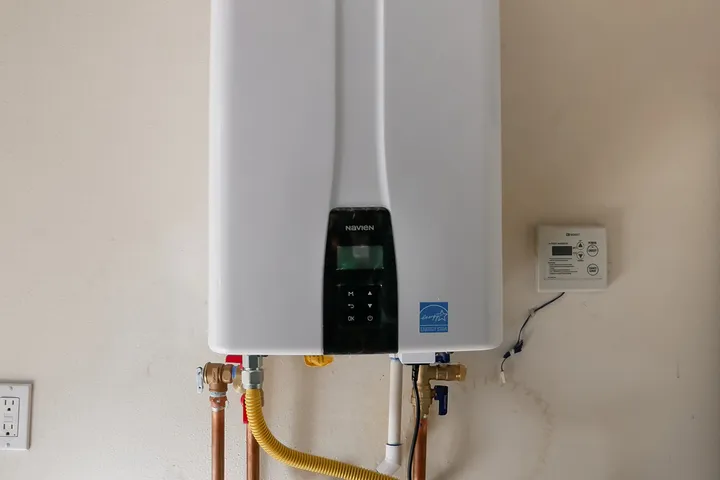
A tankless unit lasts longest, because it has no tank to rust through. The Department of Energy puts tankless units at more than 20 years, and ENERGY STAR gives them a life expectancy of 20 years.
Rheem says a tankless heater faces less long term corrosion than a tank, since many parts can be replaced instead of the whole unit. Well kept units can reach 25 to 30 years.
The catch is scale. A tankless unit heats water as it flows through a heat exchanger, and hard water leaves mineral scale inside that exchanger. A.O. Smith says that buildup damages heat exchangers, so tankless units need regular descaling.
When people ask how long can a water heater last about a tankless unit, descaling is the habit that decides the answer. Skip it in a hard water home and the unit can fail years early, which is why the maker range of 15 to 20 years is shorter than the Department of Energy figure.
Tankless units also cost less to run. The Department of Energy puts a tankless model at 24 to 34 percent more efficient than a storage tank for a household that uses 41 gallons of hot water a day or less.
On a four person household, a gas tankless costs about $345 a year to run, a gas tank about $513, and a standard electric tank about $1,257, using 2025 energy prices. A heat pump water heater is the cheapest of all at about $312 a year.
That running cost gap matters when you compare a tankless unit against a tank. The tankless unit costs more to buy and install, but it can run for twice as long and cost less each year while it does. Our guide to how to flush tankless water heater units covers the descaling routine that keeps a tankless unit at the top of its range.
What actually shortens a water heater’s life
Four things decide how long your heater lasts in a real house, and none of them is the brand on the label. Water quality comes first, then sediment, then the anode rod, then the pressure and temperature you run it at.
Hard water. Water with more than 120 milligrams per liter of dissolved calcium and magnesium counts as hard water, according to the Environmental Protection Agency, which works out to about 7 grains per gallon.
Heat drops those minerals out of the water as sediment, and the sediment settles on the tank floor and coats the heating parts. Industry data compiled from inspection records puts the effect in stark terms: hard water can cut a gas tank from about 11 years to about 5.5 years, and an electric tank from about 13 years to about 6.5 years.
Lennox puts the same point more gently, saying hard water can shrink a water heater’s realistic lifespan by 2 to 5 years without any corrective action. If your kettle furs up and your shower head clogs, your water is hard, and your heater is living on the short end of its range.
Sediment. Even in soft water, a tank gathers sediment over the years, and the layer at the bottom insulates the water from the burner or the element. The heater works harder, the tank runs hotter at the bottom, and the steel fatigues faster.
Rheem says sediment buildup can shorten a heater’s life and recommends flushing once a year. A.O. Smith says yearly servicing helps prolong its life. The Department of Energy suggests a small drain of one quart every 3 months to clear sediment between full flushes.
The anode rod. Inside every tank sits a metal rod that corrodes so the steel tank does not. It is a sacrificial part, and when it is gone, the tank itself starts to rust.
A.O. Smith says to inspect the rod once a year and replace it if it shows several inches of bare core wire. Rheem says to replace it every 3 to 4 years. A rod costs far less than a tank, and it is the cheapest life extension a water heater has.
Our guide to how to flush a water heater covers the flush, and our guide to how often you should drain your water heater sets the schedule by water hardness.
Pressure and temperature. Rheem recommends keeping home water pressure at about 40 to 60 psi, and high pressure stresses every joint and the tank itself.
The Department of Energy recommends a setting of 120 degrees Fahrenheit for most households, which is hot enough for showers and dishes and cool enough to slow scale and save energy. Running a tank at 140 degrees bakes sediment on faster and raises the scald risk, with no benefit most homes can feel.
How to tell how old your water heater is
The rating plate tells you, once you know how to read it. Look for the sticker or label on the side of the tank, find the serial number, and decode it with the table below.
Knowing the year is the first step in answering how long can a water heater last for the unit in your basement. Most brands code the build date into the serial number, though the format changes over time, so call the maker with the serial number in hand if yours does not fit.
| Brand | Where the date hides | Example |
|---|---|---|
| Bradford White | First letter is the year, second letter is the month, A is January through M is December, with no I | WC9876553 means March 2000 |
| Rheem and Ruud | First four digits are the month, then the year | 0189 means January 1989 |
Bradford White year letters repeat every 20 years, so W can mean 2000 or 2020. Bradford White says to count the digits after the two letters: seven digits means it was built before December 2007, and eight digits means after.
Seven signs yours is near the end
Age is the starting point, not the verdict. A 12 year old tank with clear water and quiet operation can keep going, while an 8 year old tank in hard water can be done.
These are the signs Rheem and A.O. Smith list, and any two of them together mean it is time to plan, not to wait. They answer how long will a water heater last for your tank better than any table can. If you are wondering how long should a water heater last in your house, these signs are the honest answer.
Age past 10 years. Rheem says to start planning a replacement around year 10. A.O. Smith says a unit over 10 years old that leaks at the base or runs erratically is probably due.
The question stops being abstract at this age and becomes a budget line. ENERGY STAR advises replacing a water heater that is over 10 years old before it fails, rather than waiting for the leak.
Water pooling around the base. Rheem says pooling often indicates internal corrosion. A leak from the tank body itself usually means replacement, because a corroded tank wall cannot be patched.
Leaks at a valve or fitting can often be fixed, so check where the water is coming from before you decide. A puddle under the tank is the one sign you should never watch for a week to see if it gets worse.
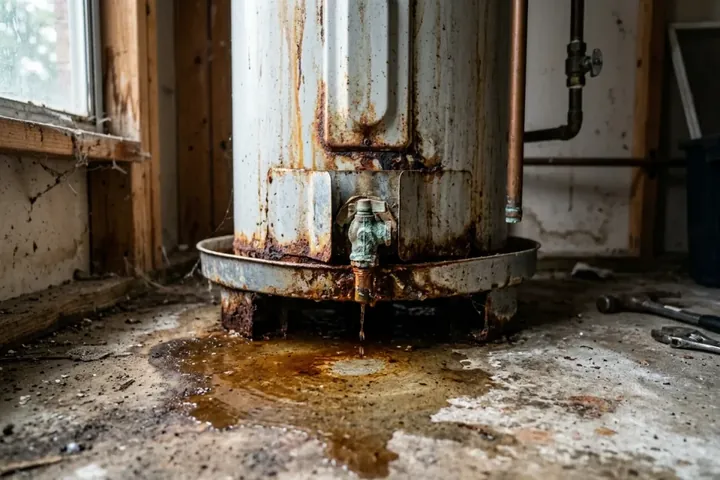
Rusty or brown hot water. Rusty water from the hot tap points to corrosion inside the tank or a worn anode rod. If the cold tap runs clear and only the hot water is brown, the heater is the source.
A rotten egg smell is a different problem: Rheem says it may point to bacterial growth in the tank. Either way, the water is telling you something has changed inside the steel.
Rumbling or popping. This usually means sediment on the tank floor, with steam bubbles popping through the layer as the burner fires. A.O. Smith says flushing is the fix, but if the noise continues after a flush, an element may be failing or the tank may be cracked.
Less hot water than before. A tank that runs out halfway through a shower, with no change in household use, is losing capacity to sediment or a failing part. Rheem ties this to sediment, worn parts, or a failing thermostat.
A heater coated in sediment also works harder for the same hot water, and the extra energy shows up on the bill. Compare this winter with last winter, not this month with last month.
Several repairs in a short time. Rheem says this suggests broader internal wear. One thermostat in 10 years is normal.
A thermostat, then an element, then a valve in one year is a heater telling you it is done.
A real decision: the 2013 tank
Take a 50 gallon gas tank installed in March 2013 in a home with moderately hard water, flushed twice in 13 years. It is now 13 years old, past the maker range of 8 to 12 years, inside the Department of Energy range of 10 to 15 years, and close to the Department of Energy average life of 14.5 years for a gas tank.
The showers still run hot, but the tank rumbles when the burner fires and the hot water runs brown for a few seconds each morning. The plumber quotes $400 to replace a failing thermostat and flush the tank.
A new 50 gallon gas tank, installed, costs $2,300 to $3,500, according to ARS national service data from January 2025 through January 2026. Rheem’s 50 percent rule says a repair is worth doing when it costs less than half the price of a new unit, and $400 is well under half of even the cheapest replacement. On the numbers alone, repair wins.
But the numbers alone miss the age. The tank is 13, the water is hard, the anode rod has never been changed, and the rumbling says sediment has been baking on for years. A repair buys hot water for now, and the tank itself is the next thing to fail.
The smart move is the repair plus a plan: fix the thermostat, flush the tank, check the anode rod, and start saving for a replacement within two years, before the tank picks the date itself with a leak. That is the judgment call the age number exists to support.
How long can a water heater last is not a trivia question. It is the number that tells you whether a $400 repair is money well spent or money thrown at a tank that is already done.
Five habits that add years to the one you have
Maintenance will not make a tank last forever, but it moves a heater from the bottom of its range to the top. These five habits are the ones the makers and the Department of Energy agree on, and they are the cheapest way to add years to the answer when you ask how long will a water heater last.
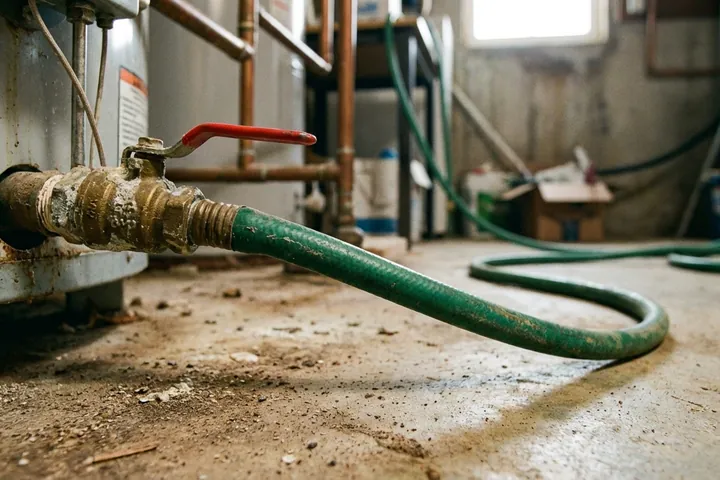
Flush the tank once a year. A yearly flush clears the sediment before it bakes into a hard layer. Rheem recommends it, A.O. Smith recommends yearly servicing, and the Department of Energy suggests a small drain every 3 months between flushes.
Our guide to how to drain a water heater walks through the steps in order, including the shutdown order for gas and electric models.
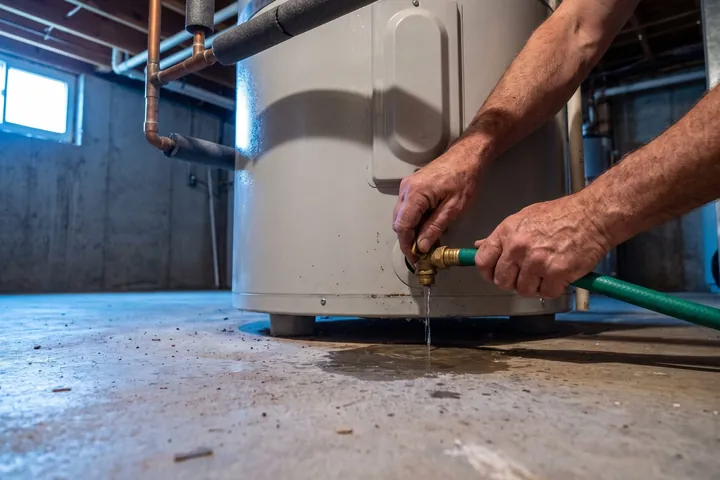
Check the anode rod every 3 to 4 years. Replace it when it is mostly eaten away, and the tank keeps its corrosion protection.
In hard water, check it sooner, because hard water eats the rod faster too. A fresh rod is the simplest way to add years without buying anything big.
Keep the temperature at 120 degrees. It slows scale, saves energy, and cuts the scald risk. Test it with a kitchen thermometer at the tap farthest from the heater.
Keep the pressure at 40 to 60 psi. A gauge that threads onto a hose spigot costs little and tells you in a minute whether your pressure is stressing the tank. If it reads over 80 psi, a pressure reducing valve is worth a plumber’s visit.
Descale a tankless unit every year in hard water. A vinegar solution circulated through the heat exchanger with a small pump keeps the scale from choking it. Our guide to how to flush tankless water heater units covers the pump loop and the schedule by water hardness.
Repair or replace: the call by age and problem
Rheem’s 50 percent rule is the simplest way to decide: if a repair costs more than half the price of a new unit, replacement is almost always the better investment. A repair can make sense when the heater is under 6 to 8 years old, the tank is not corroded or leaking, and the cost sits well below that line.
The table below applies the rule to the problems homeowners actually face, and each row is a small answer to how long will a water heater last for a heater of that age. It uses a $2,000 replacement as the example price.
| Heater age | Problem | Repair quote | Verdict |
|---|---|---|---|
| 5 years | Bad heating element | $300 | Repair |
| 9 years | Faulty thermostat | $400 | Repair, but start saving |
| 12 years | Leaking temperature and pressure valve | $350 | Repair is under the line, but the heater is past 10 years |
| Any age | Tank itself leaking | Not repairable | Replace |
Past 10 years, replacement is often the right call even if the heater still works, because older units are more likely to fail again soon after a repair. Rheem says exactly that, and it matches what the averages say: a gas tank at 12 years is already past its maker range and nearing its average life.
If the tank itself leaks, there is no decision to make. The tank is done, and the only question left is how fast you can get a new one in.
What a new one costs to buy and run
Price is part of the lifespan question, because a heater that lasts twice as long can be worth twice the price. That trade is the real reason people ask how long can a water heater last before they buy.
A standard tank replacement typically ranges from about $2,300 to $3,500 installed, according to ARS national service data, while a tankless replacement ranges from about $4,400 to $6,500. Those are national planning ranges, not a quote for your home, and gas line work, venting, and permits can move them.
The running costs tell the other half of the story. On a four person household at 2025 energy prices, a heat pump water heater costs about $312 a year to run, a gas tankless about $345, a gas tank about $513, and a standard electric tank about $1,257.
Over a 15 year life, the gap between a gas tank and a heat pump heater is thousands of dollars, which is why the cheapest heater to buy is rarely the cheapest heater to own. Warranties tell you how long the maker will cover a defect, not how long the heater will last.
Bradford White tank warranties run 6, 8 or 10 years by model, with 6 years on parts, while its tankless heat exchanger carries 12 years. A 12 year warranty tank does not magically last 12 years without maintenance, and warranties exclude damage from sediment or lime buildup. A warranty is a promise about defects, not an answer to how long will a water heater last in your house.
If the replacement is more than a year away, a plumber can still help now. A drain and flush visit runs about $200, according to Angi, and it covers the valves, the flush, and a look at the tank while it is empty. Our guide to how a water heater works explains what the plumber is looking at inside the tank.
Related guides
The four guides below pick up where this one leaves off, with the tank itself, the drain, the flush, and the schedule.
- How Does a Water Heater Work? Inside the Tank in 2027
- How to Drain a Water Heater in 2027
- How to Flush a Water Heater in 2027
- How Often Should You Drain Your Water Heater in 2027
- How Long Does a Gas Water Heater Last in 2027
- How Much Is a Tankless Water Heater in 2027
- Is Tankless Water Heater Better Than a Tank in 2027
Frequently Asked Questions
How long does a water heater last?
A standard tank lasts 10 to 15 years, according to the U.S. Department of Energy, and a tankless unit lasts 20 years or more. Makers give a shorter range of 8 to 12 years for tanks. Hard water and skipped maintenance push a tank toward the bottom of its range, and yearly flushing pushes it toward the top.
How long does a gas water heater last?
About 10 years, according to the 2007 NAHB and Bank of America life expectancy study. The Department of Energy range for all storage tanks is 10 to 15 years, and its survival curve puts the average life of a gas tank at 14.5 years. Gas tanks run a little shorter than electric tanks because the burner heats the bottom of the tank harder.
How long does an electric water heater last?
About 11 years, according to the 2007 NAHB and Bank of America study, one year more than the study lists for gas tanks. The Department of Energy survival curve puts the average life of an electric tank at 15.1 years. Electric tanks last a little longer because they have no burner, no flue, and fewer parts that can fail.
How long does a tankless water heater last?
About 20 years, according to the Department of Energy, and the NAHB study lists more than 20 years. A.O. Smith and Rheem say 15 to 20 years with proper care, and Rheem says well kept units can reach 25 to 30 years. Regular descaling is what decides which end of that range a tankless unit reaches.
How long does a heat pump water heater last?
About 10 to 15 years, according to both the Department of Energy and Rheem. A heat pump unit keeps a tank, so its life is closer to a regular tank than to a tankless unit. Rheem says cleaning the air filter every 3 to 6 months and flushing the tank once a year can stretch that to 15 years or more.
Should I replace my 10 year old water heater?
Not if it works well and does not leak, but start planning. Rheem says replacement is often the right choice past 10 years, and A.O. Smith says a unit over 10 years old that leaks at the base or runs erratically is probably due. ENERGY STAR advises replacing a water heater over 10 years old before it fails, rather than waiting for the leak to pick the date.
A water heater holds scalding water, gas or live electricity, and pressure, all in one steel tank, so give every step your full attention. A gas smell near the heater means getting everyone out of the house first, then calling the gas company from outside.
Wait until the tank is completely full before you restore power to an electric heater, and leave the temperature and pressure relief valve clear at all times.
Find the rating plate, read the year, and do the math. A tank at 8 years with clear water and a fresh anode rod has years left in it. A tank at 13 with brown water and a rumble has already told you what it is going to do next.
That is all the question of how long will a water heater last really asks: how much time is left, and what will you do with it. The age is not a guess, and once you know it, the decision mostly makes itself.
Sources: Roof and Router, How long does a water heater last; HVAC Base, How Long Does a Water Heater Last; ARS Rescue Rooter, How Long Do Water Heaters Last; Lennox, How long can a water heater last. The figures above are national planning ranges from the sources listed, not a quote for your home, so get written advice from a licensed local plumber before you budget or touch a gas appliance.