What Is a Tankless Water Heater in 2027
A tankless water heater heats water only when a tap opens, so no tank waits around the clock. Cold water runs through a heat exchanger, a gas burner or electric elements heat it in seconds, and hot water flows until you close the tap. So what is a tankless water heater but a box that makes hot water on demand?
Picture a Tuesday morning in a house with four people and two bathrooms. The first shower runs hot, the second runs warm, and the third person steps in to cold water and a bad mood. A 50 gallon tank holds only so much hot water, and once it is gone, the whole house waits for it to heat up again.
A tankless unit would not have given up, because it never stores hot water in the first place. That difference is the whole idea behind what is a tankless water heater, and it shapes every choice that follows, from the size you buy to the gas line behind the wall.
How does a tankless water heater work
Open a hot tap and cold water starts moving through a pipe into the unit. A flow sensor feels the water move, and that movement is the switch that wakes the whole machine up. Nothing burns and nothing heats until water flows, which is why people also call it an on demand heater.
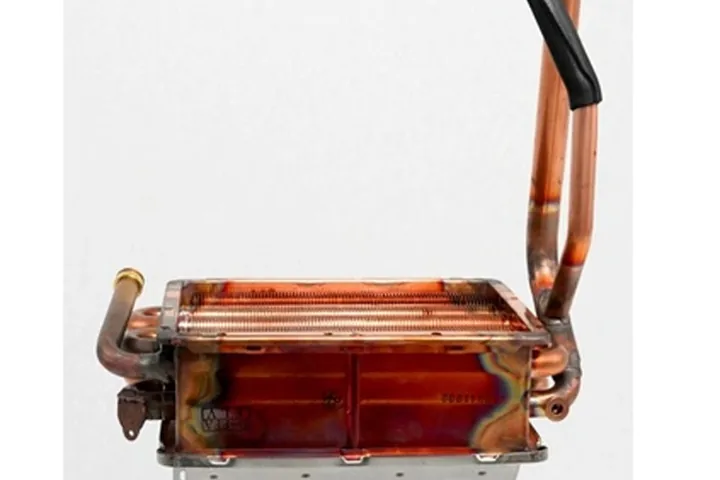
The water passes through a heat exchanger, a bundle of copper coils and thin fins that soak up heat fast. A gas burner fires below the coils, or electric elements glow inside them, and the water picks up heat as it travels through. A thermostat watches the water leaving the unit and turns the burner up or down to hold the temperature you set, usually 120 degrees Fahrenheit.
Close the tap and the flow stops. The sensor feels it, the burner shuts off, and the unit sits idle using almost no energy. That simple loop, sense the flow, fire the burner, heat the water, shut off, is the whole answer to what is a tankless water heater in mechanical terms.
Our guide to how a water heater works explains the tank version of the same job, and the contrast is the point. A tank keeps 40 or 50 gallons hot all day and all night, losing heat through its walls the whole time. A tankless unit keeps nothing hot and loses nothing to standing water, which is where its efficiency comes from.
What lives inside the box
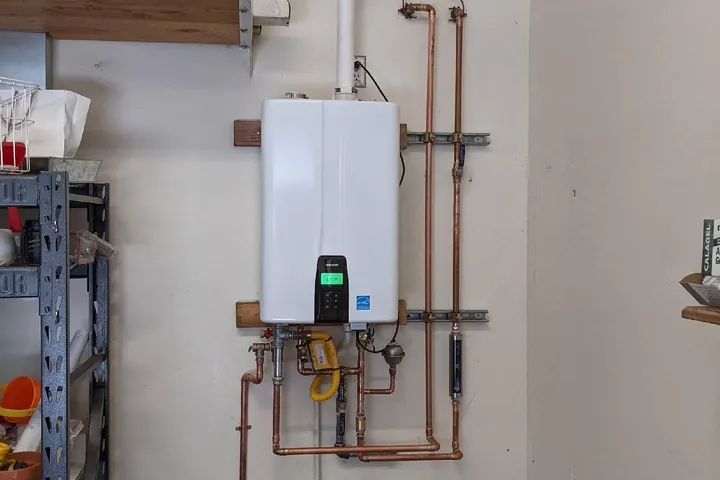
The box on the wall looks plain from the outside, but five parts do the work, and each one has a job you should know before you buy. Every part below serves the same job, heating water the instant you ask for it, and together they make up what is a tankless water heater.
The flow sensor. It measures how much water is moving and tells the burner how hard to fire. Most units need about 0.5 gallons per minute before they fire at all, according to the U.S. Department of Energy, so a tap opened to a trickle can leave you with cold water.
The heat exchanger. Copper coils and fins carry the water past the flame. Copper moves heat fast, which is why makers build the exchanger from it, and it is also the part that scale attacks first in hard water.
The burner or elements. A gas unit burns natural gas or propane in a sealed chamber. An electric unit runs current through thick heating elements.
Gas models heat more water at once, and electric models need a heavy electrical circuit to keep up.
The control board. It reads the flow sensor and the temperature sensors, then adjusts the flame or the elements many times a second. A small display on the front shows the set temperature, and many newer models let you change it from a phone app.
The vent and the drain. A gas unit needs a vent to carry exhaust gases outside, and a condensing unit also needs a small drain for the acidic water that forms when it recovers heat from the exhaust. Get the vent wrong and the unit can spill carbon monoxide into the room, so this part belongs to a licensed pro.
Venting is the part of what is a tankless water heater most buyers never see, and the part that matters most for safety.
Gas or electric: which one fits your house
Gas and electric models share the same idea, but they behave like different machines, and the fuel you already have at home usually picks the winner. The table below lines up the two fuels side by side, because the first choice in what is a tankless water heater for your home is the fuel that feeds it.
| Feature | Gas tankless | Electric tankless |
|---|---|---|
| Flow rate | 2 to 5 gallons per minute, often more | Lower, usually 1 to 3 gallons per minute |
| Best for | Whole house, several taps at once | One shower, one sink, point of use |
| Install needs | Gas line, venting, sometimes a larger gas line | Heavy wiring, often a new circuit or panel work |
| Running cost | Lower where gas is cheap | Higher where electricity is pricey |
| Efficiency rating | ENERGY STAR models need a UEF of 0.95 or higher | Already very efficient, so no ENERGY STAR label applies |
A gas unit is the workhorse. It heats water faster, it handles two showers plus a dishwasher, and it keeps working through a power cut if it has a standing pilot or a battery backup, though most modern gas units need power for the controls and the fan. An electric unit is smaller, quieter, cheaper to buy, and simpler to vent, because it has no exhaust at all, but it can struggle the moment a second tap opens.
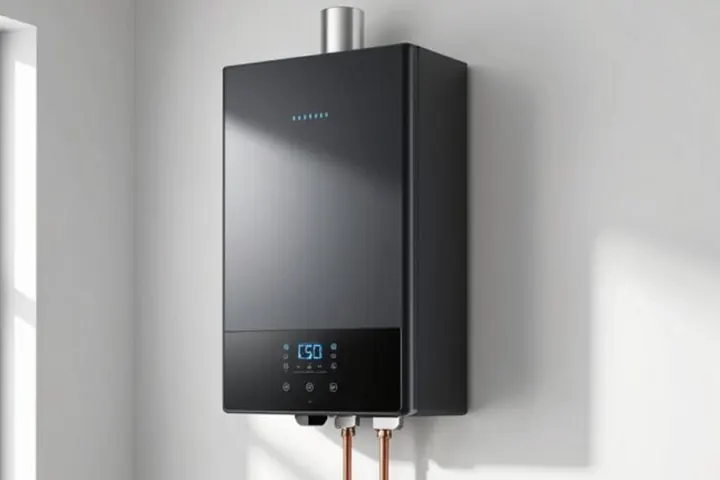
Condensing or non condensing is the second choice inside gas models. A condensing unit adds a second heat exchanger that pulls extra heat out of the exhaust, which pushes efficiency to a UEF around 0.95 or higher and lets the exhaust run cool enough for plastic vent pipe. A non condensing unit has one heat exchanger, costs less up front, and needs metal venting because its exhaust runs hotter.
One warning from the Department of Energy is worth hearing before you fall for a brand name. The big makers all build good units, and Rinnai, Rheem, Navien, Noritz, Bosch and Takagi all sell models that last 20 years with care. The installer matters more than the logo, because a badly sized or badly vented unit from the best brand still gives cold showers.
How much hot water can one make at once
A tankless unit never runs out, but it can only heat so much water at once, and that limit is the real question behind what is a tankless water heater for a busy house. The limit is flow rate, measured in gallons per minute, and it changes with the temperature of the water coming in.
Here is the math for a real family. A showerhead runs about 1.25 to 2.5 gallons per minute, a kitchen faucet about 1.5 to 2.2, a dishwasher about 1 to 2.5, and a washing machine about 1.5 to 3, according to This Old House. Two showers and a dishwasher running together need roughly 5 to 7 gallons per minute, and only a large gas unit delivers that in a cold climate.
Temperature rise is the other half of the sizing. It is the gap between the cold water coming in and the hot water you want out. In Florida the incoming water may arrive at 70 degrees, so the heater only needs to add 50 degrees to reach 120.
In Minnesota in January the incoming water can arrive near 40 degrees, so the same unit must add 80 degrees, and its flow rate drops hard.
This Old House gives a rough BTU guide by household size: about 140,000 BTUs for one bathroom with one or two people, about 190,000 for two bathrooms with two or three people, and about 380,000 for three bathrooms with three to five people. BTU is the size of the burner, and a bigger burner heats more water at once.
Do the sizing before you buy, not after the first cold shower. Measure your incoming water temperature with a kitchen thermometer at the cold tap, add up the flow rates of the taps you run together, and match both numbers against the specs on the box.
A plumber can do the same math in ten minutes, and it is the cheapest ten minutes in the whole project. It is also the step that turns what is a tankless water heater from a box on the wall into hot water at every tap.
Tankless or tank: the honest side by side
The honest answer to what is a tankless water heater versus a tank is that neither wins on every point. The table below is the short version, and the paragraphs under it are the parts the table cannot show.
| Feature | Tankless | Tank |
|---|---|---|
| Hot water supply | Endless, limited by flow rate | Limited by tank size, then it runs out |
| Energy waste | Almost none, heats only on demand | Standby loss all day and night |
| Lifespan | More than 20 years with descaling | 10 to 15 years |
| Space | About the size of a suitcase on the wall | A tall cylinder on the floor |
| Upfront cost installed | About $2,400 to $5,400 | About $1,600 to $2,400 |
| Maintenance | Descale every year in hard water | Flush every year, check the anode rod |
The efficiency gain is real, and the Department of Energy puts a number on it. In a home that uses 41 gallons of hot water a day or less, a tankless unit runs 24 percent to 34 percent more efficiently than a storage tank.
In a home that uses about 86 gallons a day, the gain shrinks to 8 percent to 14 percent, because a big household keeps the burner firing most of the time anyway. That gain is the main energy argument for what is a tankless water heater, and it is biggest in homes that use little hot water.
Two quirks catch new owners by surprise. The first is the cold water sandwich, a burst of cold water in the middle of a shower when the unit shuts off and restarts as taps open and close. The second is the wait: the Department of Energy notes a tankless unit can take 5 to 15 seconds longer than a tank to deliver hot water to a faraway tap, because the water still has to travel through the pipes.
A recirculation pump fixes both, and it costs extra.
The lifespan gap is the quiet argument for tankless. A tank lasts 10 to 15 years, according to the Department of Energy, while a tankless unit lasts more than 20 years. This Old House puts it plainly: you will likely replace a tank once or twice before you replace a tankless unit.
That only holds if you descale it, though, and a unit in hard water that never gets flushed will choke on scale long before 20 years.
What does one cost, and does it pay
The price tag is the first shock for most buyers. Home Depot publishes a national installed range for a gas tankless unit of $2,400 to $5,400, with an average of $4,300, against $1,600 to $2,400 for a tank, with an average of $1,950. This Old House puts the average a little lower, at $2,600 installed, with a range of $1,300 to $3,900 and high end brands reaching $6,000.
Realtor.com breaks the bill into parts: a whole house unit costs $1,100 to $3,500 before installation, and the installation adds $1,000 to $3,000 more when the gas line, the venting, or the wiring needs work. A small point of use unit for one sink or shower costs $100 to $300, according to This Old House, and it heats only 0.5 to 2 gallons per minute.
The extras are where budgets break. A tankless swap often needs a larger gas line, because the burner draws far more gas at once than a tank burner does, and it often needs new venting and a condensate drain.
Those three extras are the reason a $4,300 average can climb past $5,000, and they are also the reason a quote that skips them is a quote you should not trust. Ask for them in writing, because the real price of what is a tankless water heater in your house includes the gas line, the vent, and the drain.
On the savings side, ENERGY STAR estimates a typical family saves $100 or more a year with a tankless water heater. At $100 a year, the payback on a $4,300 install against a $1,950 tank runs past 20 years on energy alone, which is why the honest case for what is a tankless water heater is comfort and endless hot water, not a quick payback. The money case improves if your tank would need replacing twice while the tankless unit is still running, and it improves more if your household uses little hot water, where the 24 percent to 34 percent efficiency gain is biggest.
One last budget note: the federal 25C credit, 30 percent up to $2,000 for heat pump water heaters, ended for equipment placed in service after December 31, 2025. A unit installed in 2026 gets no federal credit, so the price you are quoted is the price you pay, and any state or utility rebate is worth checking before you sign.
Who should buy one, and who should keep the tank
A tankless unit suits a house that runs out of hot water, plans to stay put for years, and already has gas or the wiring to support one. If your mornings run four showers back to back, what is a tankless water heater to you is simple: the end of the cold shower lottery. It also suits a small home, a cabin, or an addition, where a tank would eat floor space and a small wall hung unit fits behind a door.
Keep the tank if your hot water use is light and your tank still has years left. A retired couple who use 30 gallons a day will not save enough on energy to pay back a $4,300 install, and a tank that is five years old owes you nothing yet.
For them, what is a tankless water heater is a luxury, not a need, and the tank they already own is the cheaper answer. Keep the tank too if your house has no gas line and a small electrical panel, because the upgrade bill can cost more than the heater itself.
A plumber in Pittsburgh with 36 years on the tools told Realtor.com he is not a fan, because tankless units are maintenance heavy and pricey to repair, with parts and a basic service call running $300 to $400. He has a point, and it is the same point the numbers make: buy one for the endless hot water and the long life, not because someone promised you it would pay for itself.
Five things to get right before you buy
Five checks decide whether a tankless unit feels like a luxury or a regret, and all five happen before the box comes off the truck. Each one answers a different part of what is a tankless water heater needs from your house before it works well.
Check the gas line. A gas tankless burner draws far more gas at full fire than a tank burner, and a thin gas line starves it. Ask the installer to confirm the line size in writing, because a starved unit gives lukewarm showers and an error code, not hot water.
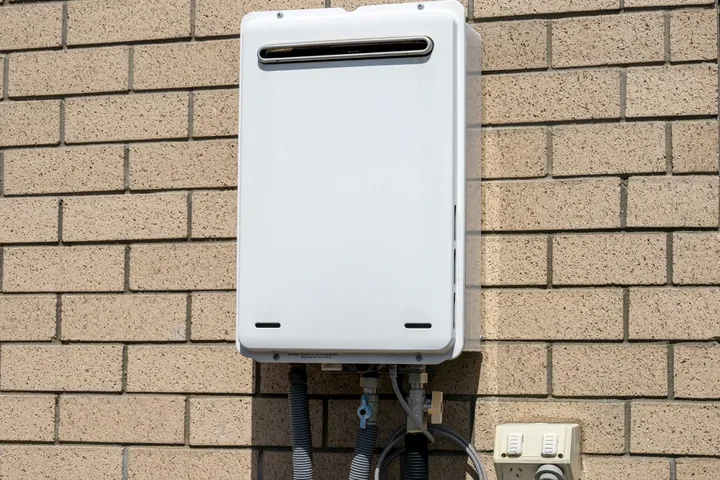
Check the venting. A condensing unit vents through plastic pipe and needs a condensate drain, while a non condensing unit needs metal venting that can cost more than the unit itself. An outdoor unit skips the indoor vent entirely, but it must be drained before a hard freeze, and it needs freeze protection where winters bite.
Check your water. Hard water is the enemy of a heat exchanger, because the minerals fall out of heated water and coat the narrow copper passages. If your kettle furs up or your showerhead clogs, plan on descaling every year, or fit a water softener first.
Our guide to how to flush tankless water heater units walks through the vinegar pump loop and the schedule by water hardness.
Check the temperature rise. Size the unit for your coldest incoming water, not your average day. A unit that sings in July can go lukewarm in January when the groundwater drops, and the fix after installation is a second unit, not a setting.
Check the permit and the pro. Most towns require a permit for a gas appliance swap, and the gas and vent connections belong to a licensed plumber, full stop. Get three written quotes, and make sure each one lists the gas line, the venting, the condensate drain, the permit, and the haul away of the old tank, so you compare real prices instead of guesses.
Keeping one alive past 20 years
A tankless unit earns its long life only if someone looks after it. Descale it once a year where the water is hard, and once every two years where the water is soft, using a small pump to run vinegar through the heat exchanger. Clean the inlet filter when the flow drops, and keep the vent clear of nests, leaves, and snow.
Watch the display for error codes instead of ignoring them, because a code that means scale today means a dead heat exchanger next year. And if the hot water starts running hot and cold in waves, check the minimum flow first: a tap opened too little will not keep the burner lit, and the fix is a wider open tap, not a new heater.
The 20 year life the Department of Energy quotes is a maintained life, not a guaranteed one. A unit that gets descaled on schedule can outlast two tanks.
A unit that never gets descaled can fail in ten years, and the maker will call it scale damage, not a defect, when you ask about the warranty. That schedule is the price of what is a tankless water heater promises on the box: endless hot water for decades.
Related guides
These four guides cover the jobs this one mentions, from how the tank works to the flush that keeps a tankless unit alive.
- How Does a Water Heater Work? Inside the Tank in 2027
- How to Flush Tankless Water Heater Units in 2027
- How Long Does a Water Heater Last in 2027
- How Long Does a Gas Water Heater Last in 2027
- How Does a Tankless Water Heater Work in 2027
- How Much Is a Tankless Water Heater in 2027
Frequently Asked Questions
What is a tankless water heater?
A tankless water heater is a wall hung unit that heats water only when a tap opens, with no storage tank. Cold water runs through a copper heat exchanger, a gas burner or electric elements heat it in seconds, and hot water flows until you close the tap. It is also called an on demand or instantaneous water heater.
How much does a tankless water heater cost installed?
A gas tankless unit runs $2,400 to $5,400 installed, with an average of $4,300, according to Home Depot published national ranges. A tank runs $1,600 to $2,400 installed, with an average of $1,950. A gas line upgrade, new venting, or a condensate drain can push the tankless bill past $5,000.
Does a tankless water heater save money?
A little, and only over many years. The Department of Energy says a tankless unit is 24 percent to 34 percent more efficient than a tank in homes using 41 gallons of hot water a day or less, and 8 percent to 14 percent more efficient at about 86 gallons a day. ENERGY STAR estimates a typical family saves $100 or more a year.
Can a tankless water heater run two showers at once?
Yes, if it is sized for it. Two showers need roughly 2.5 to 5 gallons per minute, and a large gas unit delivers 2 to 5 gallons per minute or more. Add a dishwasher at the same time and you need 5 to 7 gallons per minute, which only a large gas unit handles in a cold climate.
Why does my tankless water heater go cold in the shower?
The most common cause is low flow: most units need about 0.5 gallons per minute before they fire, so a tap opened to a trickle leaves you cold. Scale in the heat exchanger is the second cause, and it needs a descale. A burst of cold water mid shower is the cold water sandwich, when the unit shuts off and restarts as taps open and close.
How many years does a tankless water heater last?
More than 20 years with regular descaling, according to the Department of Energy, against 10 to 15 years for a storage tank. Hard water is the main threat, because scale coats the narrow copper passages in the heat exchanger. A unit that gets descaled every year in hard water can outlast two tanks.
Hot water, gas, venting, and carbon monoxide all live in the same small box, so give every step your full attention. If you smell gas near the heater, leave the house with everyone inside, then call the gas company from outside. Never work on a gas line or a vent yourself, and never run a gas unit with a blocked or disconnected vent.
The box on the wall is not magic, it is a trade. You give up the tank, the standby heat, and the low price, and you get hot water that never runs out and a heater that can outlive two tanks.
If your mornings need that trade, buy the big burner, size it for January, and descale it every year. If they do not, the tank in the corner is doing fine, and the money stays in your pocket. Know the trade, and what is a tankless water heater stops being a mystery and starts being a choice.
Sources: This Old House, Tankless Water Heaters: A Buyer’s Guide; Realtor.com, What Is a Tankless Water Heater; U.S. Department of Energy, Tankless Water Heaters; U.S. Department of Energy Energy Saver, Tankless or Demand Type Water Heaters; ENERGY STAR, Water Heaters. Treat every figure above as a national planning range from the sources named, not a price for your own home. Before you spend anything, get a written quote from a licensed plumber in your area.