How Much Does Spray Foam Insulation Cost in 2027
How much does spray foam insulation cost? Most homeowners pay $1,455 to $4,336 for a typical job, with a national average of $2,888, according to Angi data from 2026. Open cell foam costs $1 to $3.50 per square foot installed, while closed cell foam costs $1.50 to $5 per square foot.
The attic quote came in at $2,900, and the fiberglass quote came in at $900. The $2,000 gap is the whole decision behind how much does spray foam insulation cost on a real quote.
Spray foam insulation costs more than fiberglass or cellulose, and the gap is large enough that most homeowners want to know how much does spray foam insulation cost before they call a contractor. The good news is that spray foam does two jobs at once. It insulates and it seals air leaks, so drafty rooms feel warmer in winter and cooler in summer.
This guide gives you the numbers by foam type, by room, and by job size.
How Much Does Spray Foam Insulation Cost Per Square Foot?
How much does spray foam insulation cost installed? $1 to $5 per square foot in most cases. Open cell foam sits at the low end of that range and closed cell foam sits at the high end.
The exact price depends on the foam type, the thickness you need, and how easy the area is to reach.
Contractors usually price spray foam by the board foot. One board foot covers one square foot at one inch thick. To work out your own estimate, multiply the area in square feet by the thickness in inches, then multiply by the price per board foot.
Here is a worked example. A 1,000 square foot attic roof deck sprayed with 3 inches of closed cell foam needs 3,000 board feet. At $1.30 to $3.10 per board foot, that job costs $3,900 to $9,300 for materials and labor.
The same attic in open cell foam at 5 inches needs 5,000 board feet, which costs $3,000 to $8,000 at $0.60 to $1.60 per board foot.
| Foam type | Cost per board foot installed | Cost per square foot installed | R value per inch |
|---|---|---|---|
| Open cell spray foam | $0.60 to $1.60 | $1 to $3.50 | 3.5 to 3.7 |
| Closed cell spray foam | $1.30 to $3.10 | $1.50 to $5 | 6 to 7 |
Small jobs still carry the full crew cost. Most contractors charge a minimum fee of $1,000 to $2,000, even for a tiny area. A rim joist job or a single wall can cost $500 to $1,500, but the minimum fee often sets the floor.
Small jobs cost more per square foot because the crew still has to bring the rig, set up the hoses, and clean up after.

Open Cell vs Closed Cell Spray Foam
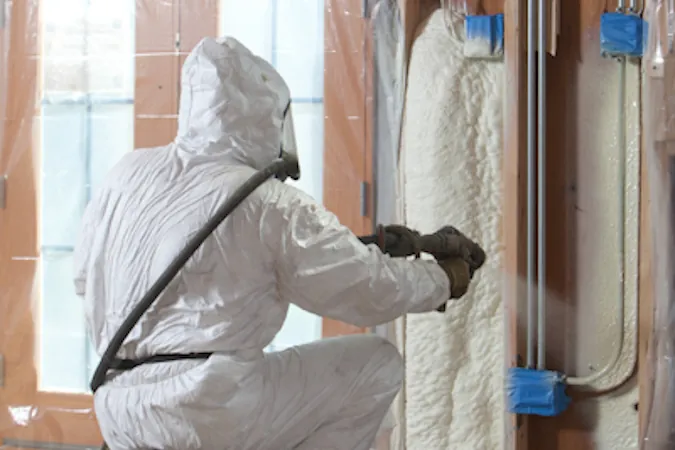
Open cell foam is soft, light, and flexible. It expands a lot as it cures, so it fills gaps and cracks in walls and attics with ease. It lets water vapor pass through, which means it can dry out if it gets damp.
Its R value is 3.5 to 3.7 per inch, so you need a thick layer to hit a high R value target.
Closed cell foam is dense and rigid. It gives an R value of 6 to 7 per inch, which is almost double the R value of open cell foam. It resists water, so it works well in basements, crawl spaces, and rim joists.
It also adds some stiffness to the wall or roof it covers. The trade off is price. Closed cell foam costs about twice as much per board foot as open cell foam.
| Feature | Open cell foam | Closed cell foam |
|---|---|---|
| Cost per board foot | $0.60 to $1.60 | $1.30 to $3.10 |
| R value per inch | 3.5 to 3.7 | 6 to 7 |
| Moisture resistance | Low, vapor can pass through | High, acts as a vapor retarder |
| Best use | Attics, interior walls, sound control | Basements, crawl spaces, rim joists, roofs |
| Expansion | Expands up to 3 inches | Expands less than 1 inch |
| Sound control | Good | Very good |
Pick open cell foam when you have deep cavities to fill in a dry area, such as an attic roof deck or an interior wall. Pick closed cell foam when space is tight, when moisture is a risk, or when you need the highest R value in the fewest inches. In a 2 by 4 wall, which is only 3.5 inches deep, closed cell foam reaches about R 21 while open cell foam reaches only about R 13.

How Much Does Spray Foam Insulation Cost by Room?
The room you insulate changes the price as much as the foam type does. Attics are usually the cheapest per square foot because the crew can move fast in an open space. Basements and crawl spaces cost more because access is tight and prep work takes longer.
Angi data from 2026 gives typical installed costs by area.
| Area of the home | Typical installed cost |
|---|---|
| Attic | $1,100 to $9,000 |
| Basement | $1,500 to $6,200 |
| Crawl space | $1,200 to $6,900 |
| Roof deck | $1,500 to $7,000 |
| Garage | $1,500 to $9,400 |
| HVAC and duct areas | $1,000 to $3,900 |
| Whole home | $4,000 to $29,000 |
Attics are the most popular place for spray foam because so much heat escapes through the roof. A 1,000 square foot attic roof deck at 5 inches of open cell foam costs about $3,000 to $8,000, and 3 inches of closed cell foam costs about $3,900 to $9,300, the same figures as the worked examples above.
Basements and crawl spaces need closed cell foam in most cases because moisture is a constant risk there. Book any roof repair work first if your roof leaks, because spray foam will trap moisture from a leak inside the roof deck.
What Makes the Price Go Up or Down?
Thickness is the biggest price driver after foam type. A thicker layer means more board feet, and more board feet means a higher bill. So how much does spray foam insulation cost in a cold climate?
The R value you need decides the thickness. ENERGY STAR recommends attic insulation of R30 to R60 depending on your climate zone, with colder zones at the high end. In a cold climate, an attic may need 10 inches or more of open cell foam to reach R38, while closed cell foam can reach the same target in about 6 inches.
New homes cost less per square foot than existing homes. A new build usually runs $1 to $4 per square foot, while an existing home runs $3 to $5 per square foot. The gap exists because an existing home needs prep work first.
The crew may have to open walls, pull out old insulation, and patch drywall after.
Labor is a large share of the bill. Insulation crews typically charge $50 to $100 per hour, and some price labor by the square foot instead. Old insulation removal adds cost too.
If the old material holds mold, mold removal costs $1,125 to $3,345 on average before new foam can go in.
Open cell foam does not act as a vapor barrier, so some jobs need a separate vapor barrier at $0.65 to $1 per square foot.
How Much Does Spray Foam Insulation Cost for a Whole House?
How much does spray foam insulation cost for a whole house? Angi data puts a whole home job at $4,000 to $29,000 installed. The low end covers a small home that already has some insulation.
The high end covers a large new build with no existing insulation at all.
Take a typical 2,000 square foot two story home as an example. The attic roof deck alone may measure about 1,000 square feet. Spraying it with 5 inches of open cell foam needs 5,000 board feet, which costs $3,000 to $8,000.
To estimate your own whole home cost, measure each area in square feet, pick a thickness, and work out the board feet for each one. Then multiply by the per board foot price for your foam type and add 10 percent for waste and tricky spots.
Spray Foam vs Other Insulation Types
How much does spray foam insulation cost next to fiberglass and cellulose? Spray foam is the most expensive common insulation, and it costs about 2 to 5 times more than fiberglass or cellulose. The premium buys air sealing that batts and blown in materials cannot match on their own.
Fiberglass batts and cellulose slow heat flow, but air still moves through them. Spray foam expands into every gap and seals the air leaks shut as it insulates.
Fiberglass batts are the cheapest option and the easiest to install yourself. They work well in open wall cavities with easy access. Cellulose is blown into attics and wall cavities and fills odd shapes better than batts.
None of these materials seals air the way spray foam does, so many homeowners pair them. They use cheap batts in large open areas and spray foam around pipes, wires, and rim joists where air leaks hide.
| Material | Installed cost per square foot | Air sealing | Best use |
|---|---|---|---|
| Open cell spray foam | $1 to $3.50 | Excellent | Attics and interior walls |
| Closed cell spray foam | $1.50 to $5 | Excellent | Basements, crawl spaces, roofs |
| Fiberglass batts | Lower than spray foam | Poor on its own | Open walls and attics |
| Blown in cellulose | Lower than spray foam | Fair | Attics and retrofit walls |
| Mineral wool batts | Lower than spray foam | Fair | Fire prone areas and sound control |
Is Spray Foam Insulation Worth the Cost?
How much does spray foam insulation cost compared with the money it saves over time? Spray foam pays for itself in homes with high heating and cooling bills, drafty rooms, or ice dams in winter. The US Department of Energy estimates that sealing air leaks and adding insulation can cut heating and cooling costs by about 15 percent on average.
Hold that 15 percent saving next to how much does spray foam insulation cost on your quote, and the payback stops being a guess.
In a home that spends $200 a month on heating and cooling, that saving is about $30 a month, or $360 a year.
Spray foam also lasts a long time. Spray foam lasts for decades, far longer than fiberglass batts, which can sag and settle over time. That long life matters when you compare the upfront cost with cheaper materials that may need topping up or replacing.
Spray foam is not worth the premium in every case. A small job under 200 square feet may cost more per square foot than the energy it saves, because the minimum job fee dominates the bill. A home that already has good insulation and tight air sealing will see a small gain from adding foam.
How to Save Money on Spray Foam Insulation
You can cut the bill without cutting corners. Use this checklist before you sign a contract.
- Get three written quotes and compare the foam type, thickness, and R value in each one, not just the total price.
- Use open cell foam in dry areas such as attics and interior walls, and save closed cell foam for damp spots.
- Insulate during a remodel or a new build, when walls are already open and prep work costs less.
- Start with the attic, which loses the most heat, and add other rooms later if the budget is tight.
- Mix materials by using spray foam only where air sealing matters and cheaper batts in large open areas.
- Ask about rebates from your state energy office before you book the work.
- Clear the work area yourself and move stored items out of the attic or basement to cut labor time.
How much does spray foam insulation cost if you follow these steps? The savings vary, but choosing open cell foam where it fits can cut the material bill by about half, and insulating during a remodel can save on prep and patching work, because the walls are already open.
Rebates and Tax Credits in 2027
The federal Energy Efficient Home Improvement Credit, known as the 25C credit, no longer applies to insulation installed in 2026 or later. The One Big Beautiful Bill Act, signed on July 4, 2025, ended the credit for property placed in service after December 31, 2025. Before that date, the credit covered 30 percent of material costs up to $1,200 per year.
If your insulation was installed and in service by December 31, 2025, you can still claim it on your 2025 tax return with IRS Form 5695.
How much does spray foam insulation cost after rebates? State rebates are still available in 2027. The Home Electrification and Appliance Rebates program, run through state energy offices, offers income based rebates for insulation and air sealing of up to $1,600.
The exact amount depends on your household income and whether your state program has launched.
The Weatherization Assistance Program also helps lower income households with free insulation, air sealing, and heating repairs through a local agency. The US Department of Energy funds the program and estimates that weatherized homes save about $372 a year on energy bills on average. A roof replacement can be tax deductible in some cases too, so it is worth checking the tax rules for any large home project you plan in the same year.
DIY Spray Foam Kits vs Hiring a Pro
DIY spray foam kits cost $350 to $800 and cover 200 to 600 square feet. That sounds cheap next to a pro quote, but kits suit small jobs only, such as a rim joist or a small crawl space. A whole attic needs several kits, and the cost climbs close to a pro price once you add protective gear and wasted material from learning on the job.
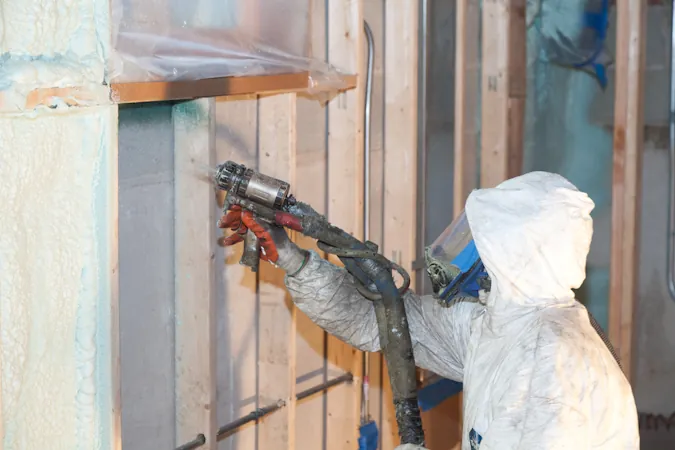
Spray foam chemicals need respect. The foam contains isocyanates, which can irritate lungs and skin and trigger asthma. Wear a respirator with the right filters, chemical resistant gloves, goggles, and a full coverall.
Keep pets and family out of the house for 24 to 72 hours after spraying, because the foam gives off fumes as it cures.
How much does spray foam insulation cost when you do it yourself? A 600 square foot attic at 3 inches deep needs about 1,800 board feet. Two kits at $600 each cost $1,200, plus about $150 for safety gear.
For most homeowners, a licensed pro is the safer choice. Pros have the right rig, they know how to hit an even thickness, and they carry insurance if the job goes wrong.
How to Get an Accurate Quote
A good quote starts with good measurements. Follow these steps before you call a contractor.
- Measure each area in square feet and note the ceiling height and the depth of the cavities.
- Note access problems such as a small attic hatch, a low crawl space, or stored items in the way.
- Ask each contractor to state the foam type, the installed thickness, and the target R value in writing.
- Ask what the price includes, such as prep work, old insulation removal, and cleanup.
- Ask if a permit is needed. Your town may ask for a building permit before the crew starts work, and the fee may sit outside the quote.
- Get three written quotes and check that each one covers the same areas and thickness.
- Check the license and insurance of the crew you pick, and ask for two recent references.
A quote without a thickness is a quote without a promise. Watch out for quotes that skip the thickness or the foam type. A low price often means a thin layer that will not reach the R value your home needs.
Ask the contractor to write the R value on the quote so you can compare like with like.
R Value by Thickness
Open cell foam gives 3.5 to 3.7 R per inch, and closed cell foam gives 6 to 7 R per inch, according to Angi, updated 9 September 2026. The table below is calculated from those per inch figures, rounded to whole numbers.
| Thickness | Open cell R value | Closed cell R value |
|---|---|---|
| 2 inches | R7 | R13 |
| 3.5 inches | R13 | R23 |
| 5.5 inches | R20 | R36 |
A 2 by 4 wall takes 3.5 inches of foam, and a 2 by 6 wall takes 5.5 inches. Open cell at 3.5 inches reaches about R13, which suits a mild climate. Closed cell at the same thickness reaches about R23, which suits a cold climate or a wall that needs a vapor barrier as well as insulation.
What Is a Board Foot
A board foot is one square foot of foam at one inch thick. Multiply the area in square feet by the thickness in inches and you get the board feet.
A 1,000 square foot attic at 3 inches thick is 3,000 board feet. At $0.60 to $1.60 per board foot for open cell foam, that is $1,800 to $4,800.
At $1.30 to $3.10 per board foot for closed cell foam, that is $3,900 to $9,300.
Ask the contractor to write the board feet and the price per board foot on the quote, so two quotes for the same job can be compared like with like.
Related guides
- How Much Does a Building Permit Cost? [2027 Guide]
- How Much Does It Cost to Repair a Roof? 2027 Guide
- Is Roof Replacement Tax Deductible in 2027? The Real Rules
Frequently Asked Questions
How much does spray foam insulation cost per square foot?
Open cell spray foam costs $1 to $3.50 per square foot installed, while closed cell spray foam costs $1.50 to $5 per square foot installed. The national average for a typical job is $2,888, with most homeowners paying $1,455 to $4,336, according to Angi data from 2026.
Is spray foam insulation worth it?
Spray foam is worth it in drafty homes with high heating and cooling bills, because it insulates and seals air leaks in one step. The US Department of Energy estimates savings of about 15 percent on heating and cooling costs. It is less worth it for very small jobs or homes that already have good insulation.
How long does spray foam insulation last?
Spray foam insulation lasts for decades. Closed cell foam lasts longer than open cell foam because it resists moisture better. Foam does not sag like fiberglass batts, so its insulating power stays steady for decades.
Do I need a vapor barrier with spray foam insulation?
Closed cell spray foam acts as its own vapor retarder, so it usually needs no extra vapor barrier. Open cell foam lets vapor pass through, so some jobs need a separate vapor barrier at $0.65 to $1 per square foot. Your local building code and climate zone decide what your home needs.
How much does spray foam insulation cost for a 1,000 square foot attic?
A 1,000 square foot attic roof deck at 5 inches of open cell foam costs about $3,000 to $8,000, and 3 inches of closed cell foam costs about $3,900 to $9,300, based on 2026 cost data. The final price depends on the thickness you need and how easy the attic is to reach.
How long do I need to stay out of the house after spray foam insulation?
Stay out of the house for 24 to 72 hours after spray foam is applied. The foam gives off fumes as it cures, and the smell can irritate lungs and trigger asthma. Your installer can give you an exact time based on the foam type and the ventilation in your home.
Stay safe with spray foam work. The chemicals can irritate skin and lungs, so leave the spraying to a licensed pro with the right safety gear. Keep children and pets away until the foam has cured and the smell has cleared.
If you hire a crew, check that they follow local building codes and cover the foam with a thermal barrier such as drywall where the code requires it.
Sources: Angi data on how much does spray foam insulation cost for 2026, based on 4,048 verified projects; Insulation R Values per square foot cost data; US Department of Energy guidance on air sealing and insulation savings; IRS guidance on the end of the 25C Energy Efficient Home Improvement Credit after December 31, 2025. Photos: spray foam application by Chicagosprayfoam, wall cavity photo and window wall photo on Wikimedia Commons, shared under CC BY SA 3.0.